I'm always excited to take on new projects and collaborate with innovative minds.
Tokyo Japan
Instead of every team running its own CI, clusters, and infrastructure, companies now consolidate into multi-tenant platform engineering ecosystems
As engineering platforms scale, you reach a stage where multiple teams, departments, or even customer groups must share the same infrastructure — especially in:
Cloud-native SDV platforms
Kubernetes-based developer platforms
Simulation/VDK workloads
CI/CD ecosystems
Data engineering environments
A multi-tenant platform allows the same underlying infrastructure to be safely shared by multiple tenants while ensuring:
✔ Zero data leakage
✔ Predictable performance
✔ Controlled resource usage
✔ Per-team cost management
✔ Independent deployments
✔ Secure isolation
✔ Consistent governance
This guide provides a full architectural & implementation blueprint for building a secure, scalable multi-tenant DevOps platform.
Multiple teams → one platform
Avoid platform duplication
Reduce operational overhead
Shared DevOps capabilities
Prevent cross-team data exposure
Ensure tenants cannot see/affect each other
Consistent CI/CD
Shared observability
Central governance
Multi-tenancy is a core requirement for any enterprise digital engineering environment.
Teams share:
Namespace
Resources
Logs
Security = basic
Good for hobby/dev only.
Each team has:
Dedicated namespaces
Strict RBAC
Network policies
Resource quotas
Isolated dashboards
This is the recommended model for enterprise SDV platforms.
Used in:
Automotive
Healthcare
Finance
Includes:
Workload identity
Encryption boundaries
Policy-as-code
Dedicated API rate limits
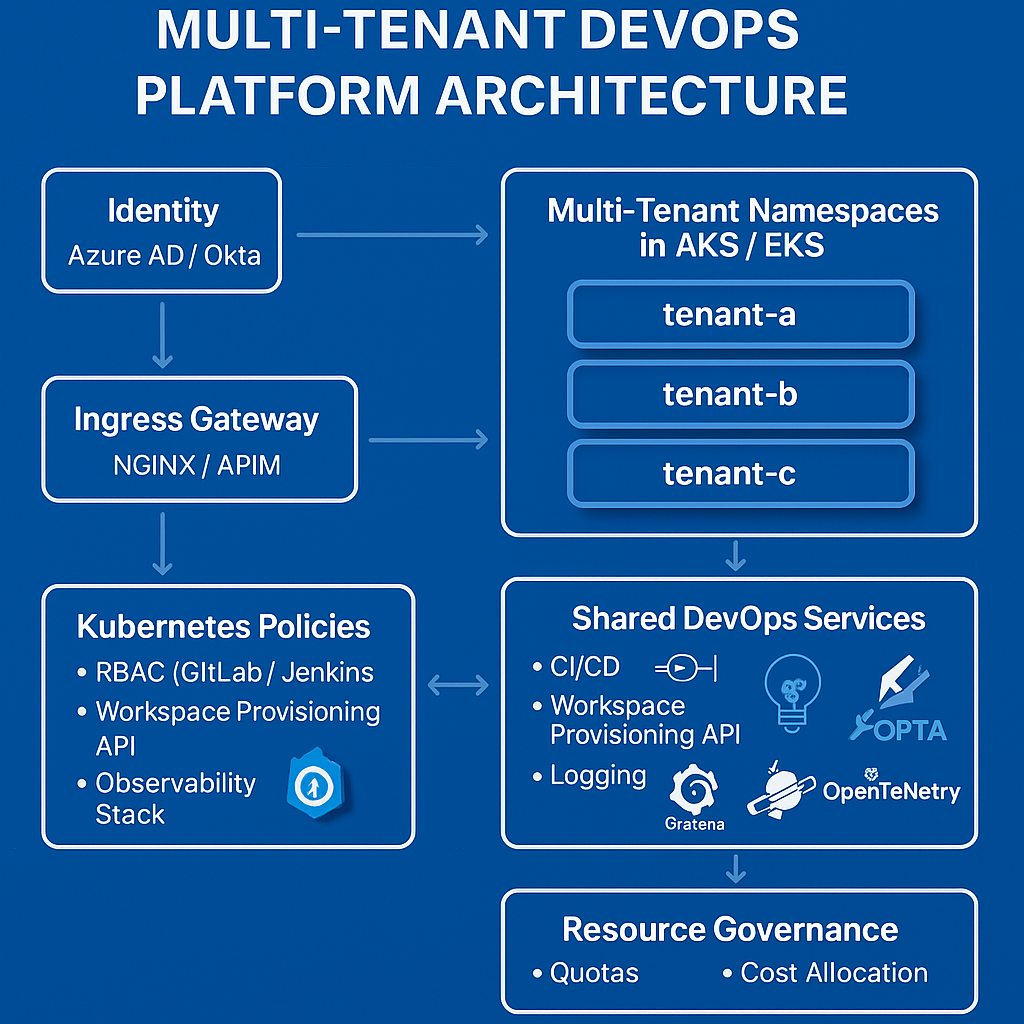
Here is a proven architecture used for enterprise cloud platforms:

This keeps tenants isolated while reusing the underlying cluster.
Each tenant (team/project/customer) must get:
Example roles:
Developer
DevOps
Viewer
Block access to other namespaces.
Control usage:
Unique API paths:
This ensures clean separation.
Use:
Developers from Tenant A cannot touch Tenant B.
Example: block cross-namespace traffic:
Block misconfigurations:
Privileged containers
HostPath volumes
Duplicate namespaces
Prevent dangerous workloads.
Assign default CPU/memory per pod.
This prevents noisy-neighbor issues.
CI/CD pipeline must:
Identify tenant
Use tenant-specific values files
Deploy to correct namespaces
Enforce access patterns
GitOps makes this easier by isolating deployments.
Use:
Grafana multi-tenant dashboards
Azure Monitor queries filtered by namespace
Loki log stream filters
API-level usage dashboards in API-M
Each tenant sees only their data.
API-Management (APIM) acts as boundary:
Per-tenant authentication
Custom request headers
Rate-limit rules
RBAC access
JWT validation
This guarantees fair usage.
Platform exposes APIs like:
Workspaces run inside tenant namespaces with:
Resource limits
Network isolation
Log redaction policies
Use:
Dedicated PVC
Separate blob containers
Access policies based on tenant
Encryption keys per tenant (optional)
Use KubeCost or custom dashboards.
Metrics per tenant:
CPU usage
Memory usage
Node hours
Storage usage
API calls
Pipeline runs
This improves budget planning.
Automate cleanup:
Delete namespaces
Recycle PVCs
Remove access control
Archive logs
Reclaim external resources
Developer pushes code
Tenant-specific CI pipeline runs
GitOps updates tenant Namespace
ArgoCD syncs only Tenant A resources
RBAC ensures access only to Tenant A
API-M enforces tenant-specific policies
Dashboard shows only Tenant A traces
Cost allocation updated
Tenant B remains fully unaffected.
✔ Use Azure AD for identity
✔ Separate K8s namespaces
✔ OPA policies for governance
✔ Encryption on storage
✔ Enable cluster autoscaling
✔ Keep logs tenant-segregated
✔ Implement FINOPS dashboards
✔ Soft-delete tenant data
✔ Keep 30-day retention
✔ Lock down public endpoints
✔ Provide templates per tenant
✔ Use golden-path CI/CD structures
❌ Shared namespace across tenants
❌ Shared secrets or configmaps
❌ No RBAC policies
❌ Logs accessible from other teams
❌ Incorrect resource quotas
❌ Mixing API paths without identifiers
Avoid these to maintain security & stability.
A secure multi-tenant DevOps platform is one of the most critical engineering investments a company can make.
When implemented correctly, it delivers:
High security
Predictable performance
Cost governance
Seamless developer onboarding
Stable shared infrastructure
Per-tenant isolation
Enterprise-grade compliance
This architecture is now a must-have for cloud-native SDV platforms, automotive engineering clouds, and any large-scale DevOps environment.

Your email address will not be published. Required fields are marked *